
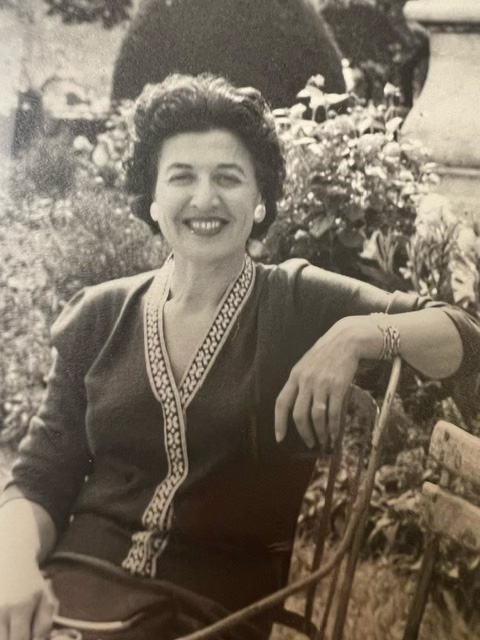
She was the daughter of immigrants from Eastern Europe who emigrated first to Winnipeg, Canada and then Los Angeles in the early 1900s. Refugees from pogroms, they believed fiercely that all four of their children should only marry a Jew. As a teenager, my mother watched her older brother fling himself on the floor at their mother’s ankles and beg her to allow him to marry the sweet and lovely gentile girl he loved. Their mother was unrelenting, and he acquiesced. Fast forward to me and my mother, me being the youngest of 3 girls, and on the cusp of a new age: rock’n’roll, the Vietnam war and women’s liberation.
As a child I had sensed a thread of regret running through Mom’s life—the way she described the avocado and fig trees in her family’s Los Angeles home, the wide, clean streets, and the abundance of flowers year-round. She had left LA to marry my father and live in Winnipeg, but her yearning leaked out in her private habits—the letters she wrote to her mother and brothers, the occasional remark she’d let slip, as in “You have to get a professional degree, Bon. It doesn’t matter if you’re living in a woodpile. It’s something you’ll always have.” And I knew Winnipeg was the woodpile.
I adored my mother when I was young. I admired her and wanted her to see me for the unique person I was, but at age twenty-three, when I walked up the jetway to fly to LA, my new chosen home, I turned one last time and saw her angry tears. An iron resolve kept me going. The suffocating, closed box of the life they were pressuring me to choose would kill me.
Five weeks after I arrived in LA, my Grandma Esther died. Mom called to say she was coming for the funeral. After the shiva at Uncle Joe’s house, I asked her if she’d like to see my apartment. She agreed, but the hard glint of her eyes behind her glasses told me nothing between us was okay.
The only sound on our drive was the V-8 engine of my used Mercury Cougar. It was awkward when I opened the flimsy front door of my West Hollywood apartment. For a moment I saw it through Mom’s eyes: the threadbare carpet, the thin sofa cushions with a cigarette burn in one corner, the cheap prints, the student era bookcase. I might have felt humiliated by her disdain of such a modest place, but no. I felt proud of it. Triumphant. These were my Picasso prints, my board-and-brick bookcase, my British pewter mugs. I was finally making my own choices.
She perched on the edge of the old green sofa as far away from the cigarette burn as possible, and I sat in my used armchair across from her. We chatted about nothing until she abruptly stood and turned around, facing the wall. Her Chanel skirt showed the rounded outline of having sat in it for hours. Her black sheer stockings had a catch at the back of her left calf. I had no idea why she was standing there like that.
She didn’t move. I looked at the wall she was facing, then at the other wall, then at the rug. Was she taking it all in? Was she going to finally tell me my new life was okay with her?
I studied the back of her, and the clasp of her pearls—a double moonstone, pale blue, translucent and surrounded by rhinestones. There was something vulnerable about the way her feet splayed out slightly, her shoes with a small protrusion in the leather on both inner sides where her bunions pushed out.
She still didn’t move. And there I was, looking at her back for a full minute, completely puzzled. Finally, I said, “Min—what are you doing???”
She practically whirled around, and then glared down at me, high color in her cheeks, her voice loud and hard. “That’s what you did to me!” she said. “You—turned—your—back—on—me.” She spit her words out.
She turned her head slightly and a shaft of sunlight from my front window caught the lenses of her glasses and I couldn’t see her eyes. I saw only LA light reflected back to me.
A moment later when I did see her eyes, they frightened me. They burned with anger. I sat immobile, unable to speak. I was twenty-three and she was fifty-eight, and I didn’t understand yet that a person could be all ages at once, that a fifty-eight-year-old could have parts of herself that were very young, with the kind of confusing, powerful emotions a twenty-three-year-old has.
It took 10 years to repair that rift, and the irony was that after all that time, I had chosen a person to marry who was not Jewish, but other than that was everything my mother wanted for me. She made her peace with it when she met him. She looped her arm through his after our lunch together and said, “Bob, I know you’re not Jewish, but you’ve got a Jewish heart.” And so the repair between us began.




0 Comments