
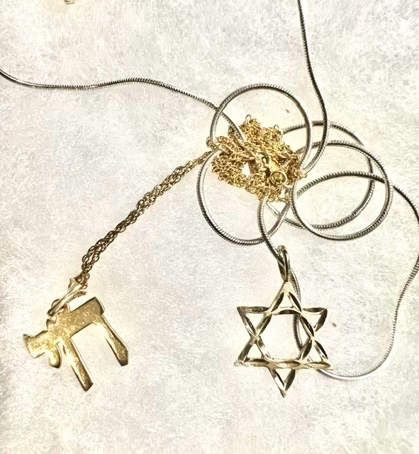
As a Jew, how much do we hide to keep safe? How much do we comfortably share that we’re Jewish without worry? Now, how much do we raise our voices loudly in protest of increasing antisemitism in this country and around the world?
I drifted far from my Jewish home of the 1950s, an era when antisemitism was clear and evident in Winnipeg, Canada. My father was a lawyer, and a City Councilman, and because he spoke Yiddish and German, he also became the attorney for the Manitoba German Society. I thought that was odd, given how few years it had been since the Holocaust, yet he was valued by those Germans, he spoke at their dinners, and he was unapologetic for being willing to represent them. He chose to champion human rights, to lobby for rescinding racial and ethnic laws that discriminated against all minorities. Passionate about that for obvious reasons, he bravely spoke out in city council meetings, got legislation passed to change discriminatory city policy and continued his work as a council member for many years.
At age 23, I left Winnipeg for California, where Jews were well-integrated into the general population. Although I loved a pastrami sandwich from Cantor’s deli, in my new home I made none of my mom’s traditional recipes. I had watched her stretch knish dough over a clean tablecloth in our dining room. I had loved her kreplach, and matzo balls so light they floated, and tender brisket and her delicate chicken soup. Before I left home, I wrote out those recipes so I could one day make them in my own home. But I never did, and I didn’t join a synagogue or observe Jewish holidays either.
It was Christmas I came to love, teaching myself how to make plum pudding, roast turkey with sausage stuffing, butter cookies with red and green sprinkles. I ate plenty of shellfish, bacon and cheeseburgers, shredded pork enchiladas, BBQed baby back ribs, all foods never allowed in my childhood home. Yet if I had to attend a church wedding it always seemed foreign to me. I tasted ham a few times but never liked it, and I was ignorant of deep Christmas traditions, never attended a midnight mass, and recoiled at the fire-and-brimstone televised preachers who tried to convince people they knew the Lord personally and what He wanted.
I married a man who was raised with such strict teachings of the Christian church that he too fled organized religion. We had no argument over religion or traditions in our home. We invented what was comfortable. Sadly, after our 33 years together, he died.
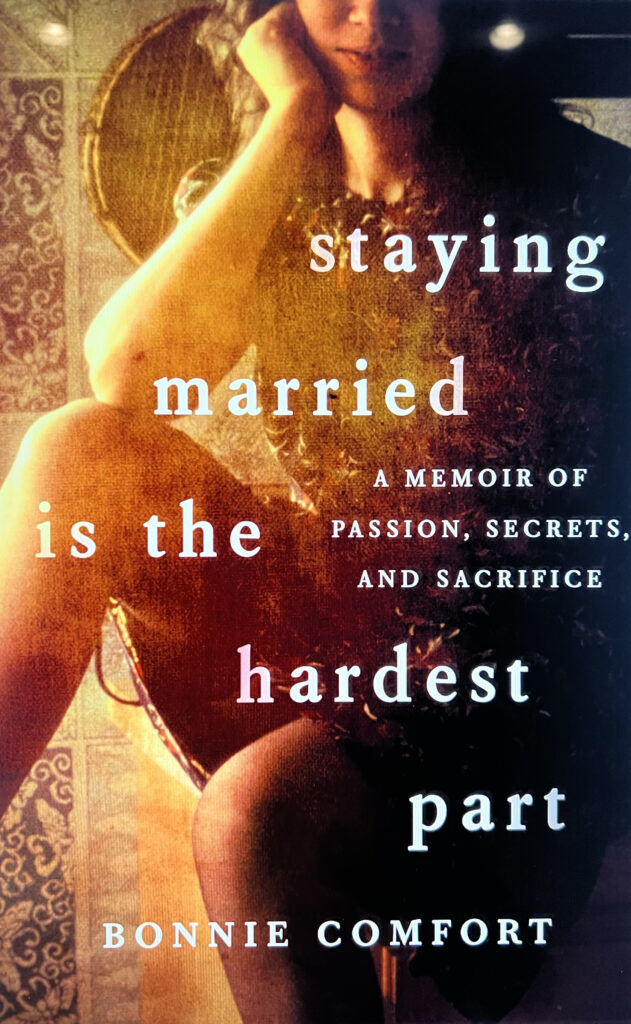
Lately I’ve been thinking more about Judaism and my place in it. My marriage memoir was published in June 2025, and it was the Jewish Review newspaper that wanted to interview me. I was also approached by the Oregon Jewish Museum and Holocaust center to speak with some other writers. I began to have a sense that although I had walked away from Judaism, it and the Jewish people had never walked away from me.
I joined the Jewish Museum, and I went to see an exhibit there by a very talented Jewish photographer. The exhibit of those photographs was stunning. Enormous black and white images of various important locations and landmarks in Berlin, including the deserted field beneath which Hitler had his bunker, the building where the “Final Solution” to the Jewish problem had been crafted, an image of an abandoned oven to symbolize the millions of Jewish bodies burned, the smoke turning the night sky an eerie dull gray. Tears welled up in my eyes as I looked at these photographs.
Before that era, Jews were well integrated into life in Germany as they are in now in the United States, but we remain at risk. Antisemitism is a sleeping giant, and for many happy years I was lured into happy complacency, living in L.A., hotbed of Jewish achievement in film, TV, professional life and business. I believed, “It can’t happen here. It can’t happen again.” I was wrong. There have been many, disturbing incidents in L.A. and across the U.S. since October 2025.
Although I stopped believing in God, I always retained my identity as a Jew. Are we safe now? Not so much. In some ways I long for the safety of my childhood home, huddled together to keep us all safe from “strangers.”
I don’t want to regress that way. Like my father, I believe that most people are good, and that joining together with people of many different backgrounds, and being known, is the best way to quell the mythology about Jews.
It’s not so different from navigating a marriage: no matter how much you feel you have in common, you’re still unique and different from each other, and to collaborate requires patience and acceptance of the Other.
This year, I’m going to try some of my mother’s recipes to bring back at a visceral level what it always felt like to enjoy being Jewish. I might even attend a High Holiday service. But I’ll start with cheese kreplach. My favorite, always served with butter and sour cream. Shalom Haverim.




0 Comments